Comments Off on Busting food bank myths with Feed Ontario!
Busting food bank myths with Feed Ontario!
“Why don’t food bank users just get a job?”
“If we increase social assistance, won’t that make people not want to work?”
Food banks have been getting a lot of media attention due to the overwhelming demand for emergency food support. Unfortunately, a lot of misinformation is also being spread about what is causing this crisis.
In December, Feed Ontario hosted a panel discussion to bust some of these myths and misconceptions in our sector. We joined colleagues from food banks across the province to field questions pertaining to our work and the people who access our services.
Chiara Padovani, North York Harvest’s Senior Specialist, Advocacy and Community Engagement, joined the panel to tackle questions from Ontarians about who is really causing the housing crisis, the realities of living on social assistance, and the solutions desperately needed to reduce food bank use.
Watch the full panel below
Thank you to Feed Ontario for having us and thanks to our fellow panelists:
Myles Vanni – Inn of the Good Shepherd, Sarnia
June Muir – UHC -Hub of Opportunities, Windsor
Robbie Donaldson – Salvation Army – New Liskeard
Comments Off on Food for Thought: Food banks need solutions, not scapegoats
Food banks need solutions, not scapegoats
In our Food for Thought series, individuals within North York Harvest Food Bank will share their experience in matters pertaining to food insecurity and poverty. This series will share ideas, lessons learned, and challenge misconceptions as we work toward our vision of a community where all members are able to meet their food needs.
Written by Chiara Padovani; Senior Specialist, Advocacy and Community Engagement
I’ve been a food bank worker at North York Harvest for almost a decade. I have dedicated my life’s work to ensuring people in my community have enough food to eat: a basic human right that is needed in order for people to stay alive. I’m glad the crisis in food banks is getting attention, but I’d like to set the record straight.
Yes, there is a crisis in our food banks. Yes, there’s an affordability crisis in our city. But no, international students or immigrants are not to blame. Everyday, food banks encounter heartbreaking stories of people who through no fault of their own cannot manage to keep themselves and their families fed. They’re battling an impossible system that bears down on them every day with no reprieve. And every day I have to contend with the fact that I will never be able to fully solve the problems that they’re dealing with, I can only offer some food support so that they don’t go hungry.
Two months ago I met an international student, *Sharla, who came to our food bank for the first time and she was panicked. She said she had to cut
the hours she was working in half because of a new immigration policy limiting how many hours international students can work. Suddenly out of nowhere, she had to survive on half her income and didn’t know how she could afford to pay the rent. In the same breath she asked me about volunteering at the food bank because now she can’t work full time.
These are the people we’re told are taking advantage of our food banks? Or causing the affordability crisis? Give me a break. It’s scapegoating, and we don’t have to buy it. I will not sit silently while the work that I have been dedicating my life to has been weaponized to push an anti-immigrant and xenophobic narrative that does nothing to serve regular people who are struggling day to day, and only serves as a distraction from a broken economic system.
In fact, Sharla’s story sounds a lot like every other person’s story who comes through our doors whether they were born in Canada or not.
Here’s the truth: the affordability crisis we’re facing in Toronto and across the country has nothing to do with what country your neighbour, classmate or coworker was born in – and believing it does, is just a distraction from the real problem.
The number one reason people come to food banks is because they can’t afford their rent. Sharla isn’t raising your rent – your landlord is, and the provincial government isn’t just letting them get away with it, they’re making it easier by removing rent controls.
The largest group of new food bank clients are workers, which means even if you’re working full time, you still can’t afford the groceries you need. Sharla doesn’t cut your hours or pay you a wage you can’t afford to live on – your employer does, and the provincial government is incentivizing them to do so by refusing to legislate equal pay for part-time, casual, contract or temporary work.
Scapegoating immigrants, international students, migrants and refugees isn’t just a harmful distraction from the real problem, it also gets us further and further away from the solutions we actually need. Newcomers like Sharla are not the reason your rent is unaffordable, that the company you work for is extracting as much profit as they can without compensating you fairly, that grocery prices are too high, that formerly stable well-paying jobs are being replaced with temp labour. This is our fault, not theirs. We have enabled this system to thrive and to push our communities to the brink.
Because instead of implementing rent control to stabilize skyrocketing rents or implementing equal pay legislation to curb the rise of low-wage, precarious work – the kind of things that would help everyone and reduce the need for food banks in the first place – we’re being sold that the solution to our problem is just making life more difficult for Sharla?
I don’t buy it, and you shouldn’t either. Sharla deserves better than this, and so do we.
Comments Off on ISV rallies community to give back
Islamic Society of Vaughan joins North York Harvest for day of community giving
At North York Harvest we’re doing everything we can to ensure our community members can meet their food needs – but we can’t do it alone.
On November 30 the Islamic Society of Vaughan stepped forward with an incredible gift of $25,000 that was used to purchase nutritious food to support our neighbours in need. Through their donation, we were able to purchase:
6,048 cans of sweet peas
5,100 bags of pasta
10,752 cans of kidney beans
4,320 cans of pasta sauce
Fifty members of the Islamic Society of Vaughan also joined us at our warehouse to sort and prepare the food for distribution themselves, sorting over 27,700 lbs. of food!
It was a joyous day of community care, teamwork, and compassion that will send positive ripples out into our community for the weeks to come.
Comments Off on Annual food drive inspires community pride!
How a food drive became a source of community pride
What happens when you combine a DJ booth, a townhouse complex, and neighbours who are passionate about giving back?
The LaRose townhouse complex has answered that it’s a much-anticipated neighbourhood party that collects food and funds for North York Harvest Food Bank!
Matt Foran spearheaded this food drive starting in 2021, getting his family involved to make posters and encouraging his neighbours to join together to help people facing food insecurity.
With the soaring cost of housing and food, “The food drive notion is very relatable because people recognize it’s tough for them too,” Matt says.
Fighting food insecurity also runs in the family: His father started the Cambridge Self-Help Food Bank, and his cousins started a food bank out in Sudbury.
Every year the neighbourhood comes together for the Community Giving Day, an event where folks can drop off donations, but also hang out and connect with their neighbours while Matt often DJs to really make it a party!
“It’s become a source of community pride,” Matt says, “and it’s become something that people look forward to. When they see me walking my dog they ask ‘when it’s going to happen, what’s our goal?’”
Each year they try to start with a goal of $3,500 but this year Matt said they had to be ambitious because of the growing need they are seeing in their community.
This year the food and fund drive exceeded their target, bringing in $6,400 plus 465 lbs of food!
The Community Giving Day has even spread beyond the LaRose townhouse, with donations coming in from all over the city.
“it was amazing to see the list of donors and people I hadn’t met before, they heard about it through friends and neighbours. It’s wonderful it brings people together like this,” Matt says.
Thank you to Matt and everyone at the LaRose townhouse complex, this generosity will directly support nearly 30,000 client visits across our network, and help individuals and families meet their food needs.
Be a Harvest Hero
Learn how you can get involved and make a difference as we work towards our vision of a community where all members are able to meet their food needs.
Comments Off on Food banks can’t solve food insecurity
People aren’t just falling through the cracks, the ground is collapsing beneath their feet
In our Food for Thought series, individuals within North York Harvest Food Bank will share their experience in matters pertaining to food insecurity and poverty. This series will share ideas, perspectives, and lessons learned as we work toward our vision of a community where all members are able to meet their food needs.
Written by Sarah Watson; Director of Community Engagement
Each year at this time, North York Harvest Food Bank, in partnership with Daily Bread Food Bank, releases our annual Who’s Hungry Report. In our new 2024 report you will see that:
More than 1 in 10 Torontonians used a food bank last year
9 in 10 food bank clients live in unaffordable housing, with 20% of clients spending their entire income on rent
49% of clients have at least one member of their household who is employed
These numbers, while incredibly distressing, are very much in line with what we have seen for the last four years, and sadly will come as no surprise to many. They are telling us that we are in the midst of a poverty and food insecurity crisis in our city, but after four years, they are also telling us something more.
The spirit of food banks is neighbours helping neighbours and that is a beautiful thing. But community care at this level is a clear sign of systems failure. Our support systems and our social safety net have been allowed to fray to such a level that people aren’t just falling through the cracks, the ground is collapsing beneath their feet.
Food banks cannot fix this. The supports we provide are critical, but on their own they are not a solution.
For years the Who’s Hungry Report has clearly shown that to solve this crisis what our community members need is affordable housing, access to decent work that pays a living wage, and social assistance rates that don’t leave them in legislated poverty.
Until we see these things, the situation will not change.
North York Harvest and our member agencies need support in order to ensure that people have access to the food they need today. Thanks to you, we have been able to meet record levels of demand from our community this past year, and we are so thankful for your partnership.
But we are also asking you to join us in the fight for long term solutions so that together we can build a city where all people are able to meet their food needs.
To learn more about what we are seeing in food banks across the city, and how we can all work together for long term solutions,please read our report.
Ten years ago, Berry Meyerowitz launched a community food drive with his family around Halloween with the tagline: We Scare Hunger.
“My family and I are very fortunate. I’ve always wanted the kids to understand how lucky they are, and that we need to volunteer and help other people who are in need,” Berry says.
This has since grown to become one of the longest-running food drives in North York Harvest’s history!
For a decade this family initiative has been collecting essential food to support nearly 30,000 individuals and families who rely on North York Harvest Food Bank. Each of Berry’s children have taken turns leading the family food drive: They plan out the routes in their neighbourhood and recruit friends at school to help deliver flyers and collect food donations.
Passing the torch
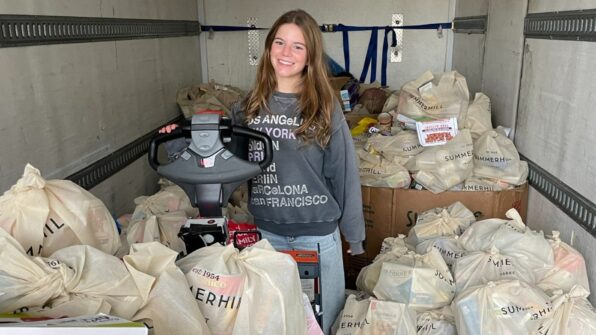
With three of his children now in university, the torch was finally passed to his youngest daughter, Jordy, this year.
“I learned a lot from our past food drives, and especially over the past two years when my sister spearheaded the food drive at our school,” Jordy says.
This year Jordy recruited an astonishing 50 students from Havergal College to help run the food drive.
“The response from students who volunteered to help was incredible, which made it a lot more fun as we were one big team!” she says.
In the earlier years, about 500 homes would be targeted for donations, yielding about 2,000 lbs of food. But this year Jordy and her team contacted 2,000 homes, collecting 5,350 lbs for our community!
“I want this initiative to spread to other communities, where people who see this think ‘wow this is so easy to achieve!’ And do it in their own neighbourhoods – we could take this grassroots initiative all over the city!” Berry says.
Thank you to the Meyerowitz family and all the students at Havergal college who have helped to bring this beautiful community initiative to life year after year! Your hard work and compassion makes a real difference.
Be a Harvest Hero
Learn how you can get involved and make a difference as we work towards our vision of a community where all members are able to meet their food needs.
We’re pleased to share our biannual Impact Report, a snapshot of the amazing work we have accomplished together this year.
Between March-August 2024, we made significant strides toward meeting the needs of our community.
In just six months, we distributed 1.6 million lbs. of food across our network, a 36% increase over last year!
That includes our staple non-perishable food items, but also high-quality items like fresh produce. We have been working hard to source more fresh food for our clients through various community partnerships – leading to an astonishing 462% increase in fresh vegetables being distributed across our network.
The support of our community is critical to nearly 30,000 neighbours who rely on North York Harvest Food Bank for emergency support – but your impact doesn’t stop there.
By moving beyond traditional food bank models and offering innovative programs including Leadership in Logistics, focused advocacy, and our social enterprise, FoodReach, our work targets the root causes of food insecurity and poverty.
Together, we are building a community that is more equitable, resilient, and where all members are able to meet their food needs.
Who’s Hungry Report 2024 – Trapped in Poverty: Unprecedented Hunger in Toronto
In partnership, North York Harvest Food Bank and Daily Bread Food Bank have released Who’s Hungry 2024— an annual profile of food insecurity and poverty in Toronto.
In just one year, we saw nearly one million more food bank client visits at a record-breaking 3.49 million visits. That’s more than the population of Toronto.
Almost 155,000 new individuals started using food bank services for the first time this past year — a 222% increase compared to just two years ago and over four times pre-pandemic
levels.
Even with food bank clients reporting higher employment rates and wages, the rising costs of living are making it impossible to keep up. More people in our city, from all walks of life, are being trapped in cycles of poverty every single day.
“It isn’t about who made the right choices and it isn’t about budgeting. It’s so far beyond that. It’s about our support systems and our social safety net that have been allowed to fray to such levels that people aren’t just falling through the cracks, the ground is collapsing beneath their feet,” says Sarah Watson, North York Harvest’s Director of Community Engagement.
Key findings from the report:
57% of clients cited the high cost of living as their reason for visiting the food bank
Food bank clients have a median monthly income of $1,265 – this is just over half Toronto’s Official Poverty Line ($2,397) for a single person
Almost 9 in 10 clients (87%) live in unaffordable housing, meaning they spend more than 30% of their income on rent and utilities
58% are from single-person households
50% missed a meal to pay for something else
49% of food bank clients have at least one member of their household who is employed
Our city is at a breaking point, and so are our food banks. Food banks cannot fix food insecurity, and we can’t keep up with this demand.
We need every level of government to come to the table and finally take meaningful action to address this crisis. Our clients have made it clear what they need:
Affordable housing
A higher minimum wage
Increased social assistance rates
Newcomer supports
Employment support
We are raising the alarm on food insecurity, and together we can be loud enough that we are impossible to ignore.