Tag Archive: poverty

  1. Basic Income Basics

    1 Comment

    There has been quite a lot of talk about basic income lately in the news.  A basic income is a guarantee to Canadian families and individuals that they will be able to meet a minimum income level regardless of employment status.

    This could mean big things for the hundreds of thousands of people in Toronto that struggle to make ends meet to pay for everyday needs such as rent, utilities, transit and food.

    This has come up for a lot of debate among Canadians. It also raises a lot of questions about the impact on our communities and economy. In an effort to answer some of the most asked questions about basic income,  I spoke with Elaine Power, co-founder of the Kingston Action Group for Basic Income Guarantee


    How do you think basic income will benefit the community?

    If we had a basic income program that was available to all who needed it and a basic income program that effectively eliminated poverty, there could be dramatic benefits to the community. The research suggests that public health would improve and health care costs would drop. Eliminating poverty means that kids would have a better start in life, do better in school and have fairer chances in life, and this could also decrease crime rates over time.

    If we take away the desperate need for people to find any kind of work that they can, it could liberate people to engage their passion and contribute to their communities through volunteer work and the arts, or to take risks, e.g., with a small business, that they wouldn’t otherwise do. When people have basic economic security, it enables them to dare to do new & different things.

    I believe that a basic income program will help build social solidarity, to rebuild a sense of the collective, that we are part of neighbourhoods and communities.

    How will this impact the economy & the taxpayer?

    People who live in poverty spend their money on basic necessities, like food, shelter, clothing, activities for their kids. They won’t be taking their money out of the country for expensive vacations. That will have an economic multiplier effect, and could make a profound impact in smaller, more rural communities that are struggling. 

    Research shows that poverty has a high economic cost and that poverty reduction has a big return on investment. A report by the Ontario Association of Food Banks suggested “With the huge savings that could be achieved over time by reducing poverty and its burdensome social costs, the province could very likely pay for the need mix of policies without asking taxpayers for anything more.”  The Canadian Centre for Policy Alternatives has calculated that every dollar invested in reducing poverty would result in about a $2 return on investment. In other words, poverty reduction is at worst cost-neutral and likely would save money over time.

    Do you feel as though there could be any negatives/drawbacks that come from having a basic income?

    Well, the negatives or drawbacks depend on the type of basic income program that would get implemented. There are different models. Some on the political right would like to see the implementation of a basic income in order to reduce other government supports and services, like public housing. This would not improve the lives of people living in poverty or likely reduce poverty overall, because people would have to pay more of their income for what are now public services. We would not see the types of economic savings I mentioned above in that case.

    I am a proponent of a progressive basic income that is part of rebuilding the social safety net, would improve the lives of people living in poverty and would result in dramatic reductions – or the virtual elimination – of poverty.
    How will this affect the food bank and food bank users?

    The best sign of the effectiveness of basic income or any poverty reduction/elimination strategy would be that food banks are able to close up because of lack of demand. Those who founded food banks back in the 1980’s thought that food banks were an “emergency” response to an economic downturn and that they would close once the economy improved. I have a report from a meeting of food banks in Toronto and area from 1991 that wrestles with the question of when and how Toronto food banks might close. An effective basic income would allow food bank users to acquire food like everyone else. They still might choose to attend hot meal programs, food skills programs, community gardens and community kitchens – but there will be more freedom and choice to do that, not a sense of dire need.

    Is the proposed amount of $16,989 enough to get by for individuals?

    Like social assistance, the problem with a fixed amount is that the cost of living varies quite a lot across the province – from Toronto to Windsor to northern Ontario. As I understand it, the rationale for making it less than the LICO ( low income cut-offs) or the LIM ( Low Income Measure) is that people will get other federal income transfers, like the GST credit. But I suppose part of the idea of the pilot is to assess if the amount is enough.

    Others, like Guy Caron, who is a candidate in the federal NDP leadership race, has proposed a basic income that would be set using the Low Income Cut-off or LICO which is adjusted for city and family size.

    What do you say about the idea from opposers that people will go on BI just to “stay home and be lazy”?

    This is probably the most common oppositional response to the idea!!

    If you ask people if they (personally) would just stay home, everyone says “of course not!.” The reality is that about 70% of people who live in poverty are working, which speaks to the inadequacy of minimum wages.

    The reality is that any basic income, whether the Ontario pilot amount or an amount tied to the LICO, is not luxurious. Most people will want to seek paid employment to supplement their incomes. And most people work for reasons other than money.

    And the other issue that this objection is based on is that the only work that is valuable is paid employment. We do all sorts of unpaid, unrecognized, invisible work at home and in our communities, including all the volunteer work that gets done for and at food banks. This is valuable and important work. What basic income will help us do is to decide where to put our time and energies in activities that are meaningful and important for us and for our communities. Some people may “stay home and be lazy” for a little while. Most people would not do that for very long – and if they do, perhaps they need other services to help them find meaningful activity.

    The benefits of a progressive and effective basic income for those living in poverty and for our communities overshadow the objection that a small percentage of people might “stay home and be lazy.”


    The idea of a basic income is a very exciting move forward in our communities. To learn more about the basic income pilot project, visit https://www.ontario.ca/page/ontario-basic-income-pilot

    More Resources:

    Kingston Action Group for Basic Income Guarantee
    Basic Income Initiative

    Basic Income Canada Network

    Subscribe to our mailing list

    * indicates required


  2. A Family Away From Home

    2 Comments

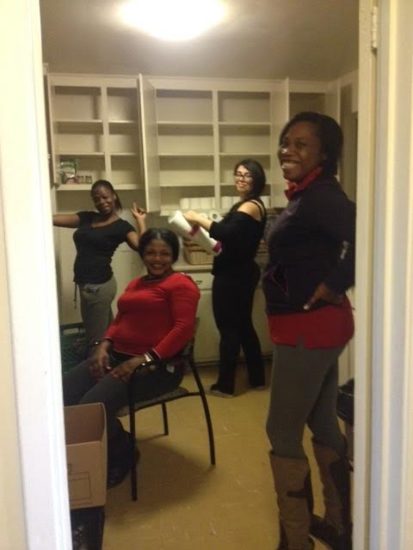
    Recently, I had the opportunity to visit with the incredible volunteers and clients at the Bathurst Finch Community Food Space.  Located in a tiny room inside Northview Heights Secondary School, the hustle and bustle of getting prepared for the upcoming drop in made the room buzz.  Operating outside of school hours, volunteers make sure the shelves are stocked and fridges full to help community members put food on the table.

    Elis, who manages the food space, treats everyone that enters like family.  Everyone is in this together and a VIP in the eyes of the caring volunteers.

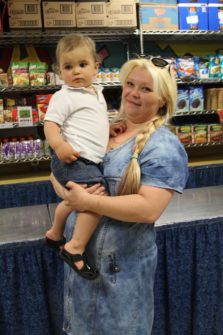
    One of the VIP clients using the food bank is Anna.  Anna has been living in Canada for 11 years after leaving Uzbekistan because she was unable to find work.

    After working 9 years at local Russian grocery stores, Anna had a child named Nikita and found herself out of work in order to take care of him each day.  She had to go on social assistance but unfortunately that wasn’t enough to cover all of her expenses from rent and utilities to food and baby supplies.  She was in a bind.

    While searching for a way to get baby powder and baby food, Anna came to the Bathurst Finch Community Food Space. When she arrived, the helpful volunteers let her know that not only she could receive baby products, but she was also given food for herself.  Anna was amazed by the kindness and generosity that was located right in her neighbourhood. She has been coming to the food bank for the past year now which has helped her stretch her small income.

    To get to the food bank, Anna walks with Nikita in his stroller.  During the harsh winter months, she was unable to take her stroller through the icy and snowy sidewalks and had no way to access the food bank.  Thomas, a volunteer, took the time to drop off food to her home for three months so Anna and Nikita wouldn’t have to go without.  “It was amazing that someone was willing to come and help us out when we couldn’t get around,” says Anna, “the food bank volunteers are wonderful!”

    After Anna’s father passed away, her mother is still living in Uzbekistan alone.  Anna hopes that her mother will be able to join her in Canada so they can be together again.  “If she comes to stay with me, she’ll be able to help take care of Nikita so I can go back to school and get a full time job,” says Anna who dreams of becoming a paralegal one day to support her family.

    Anna would recommend that anyone who needs help in her neighbourhood visit the Bathurst Finch Community Food Space.  “They are so caring and have been so helpful to Nikita and myself. If someone is in need of help they will bring you in and treat you like family.”

    At the Bathurst Finch Community Food Space, it is about more than just putting food on the table, it’s about bringing family to that table.

    Would you like to support people in your local food bank like Anna?  Make a donation here

    Want to join a team of volunteers making it happen in the food bank? Check out our latest volunteer opportunities

    Subscribe to Our Enewsletter

    * indicates required


  3. Everyday Hero

    Comments Off on Everyday Hero

    Guest blog by Shirah Stern

    Not all heroes wear capes.

    One everyday hero located right in your community is Kayla*. I recently had the opportunity to meet Kayla at the North York Harvest Annual General Meeting back in February. We were in a workshop together and she shared her experiences as a food bank volunteer. I needed to hear more so I could share her story with you.

    Kayla has been a volunteer at her local food bank for more than two years dedicating her time six days per week. This is quite incredible as Kayla suffers from many health issues such as a degenerative disk disease in her back, panic attacks, insomnia and is waiting to have knee surgery. This doesn’t stop our hero though; she chooses to work through the pain to make a difference in the lives of her neighbours in need. “If I could have sleepovers here I would!” jokes Kayla.

    Kayla’s tasks at the food bank include receiving deliveries, stocking shelves, serving clients and records management. She even packs and delivers food hampers for the “Fresh Start” program that does home deliveries for seniors as well as those unable to physically make it to the food bank. The services she and her other fellow volunteers provide benefit children, families, seniors, those with disabilities and people who can’t leave their home.

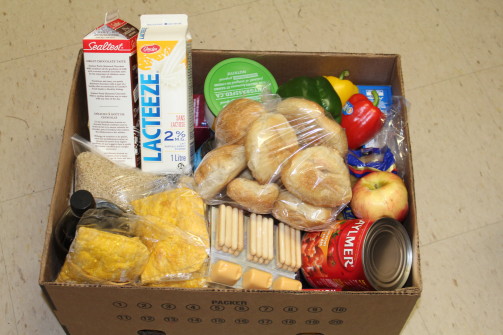
    A typical food hamper from a NYH food bank

    A typical food hamper from a NYH food bank

    Regardless of Kayla’s health problems, she feels that giving her time at the food bank gives her something else to focus on and a purpose. She strives to make a difference in the lives of her fellow neighbours. This can be done through her daily food bank tasks or even going above and beyond to help someone in need. One particular story of Kayla’s is a time that she was able to assist a client with her job search. The client had needed to know CPR in order to be eligible for a job but could not afford the training. Kayla took the time to research and found a course that was offered for free.

    Kayla told me that seeing a smile on the face of someone she has helped is so rewarding in her work.

    It absolutely blows me away when I see this kind of dedication from volunteers. And it is throughout the network! Each day volunteers take time out of their day to come in and help their neighbours meet their food needs.

    Without your support, we wouldn’t be able to have incredible stories like this to share. From you to me, me to Kayla, Kayla to the client and back to you again – we are really part of something bigger than ourselves. I feel that being able to share these stories truly closes the circle of connectivity in our community

    Join Kayla in being a community hero!

    Together we all work as a community to make a difference for more than 15,000 people that access these types of programs each month!

    Donate today!

    Volunteer!

    *Name changed

    Subscribe to Our Enewsletter

    * indicates required


  4. Poverty and the Ontario Budget

    Comments Off on Poverty and the Ontario Budget

    Many things have changed to improve our lives over the past 20 years. In the 90’s cell phones were most regularly seen on television, and even then they were huge and clunky. Video calls, now an every day occurrence, were the stuff of science fiction movies. We’ve made progress on a lot of fronts, but sadly, dealing with poverty is not one of them.

    Ontario just released Budget 2017 – A balanced budget for a stronger, healthier Ontario, which includes new measures to support low income individuals in our province, such as universal drug coverage for youth, a basic income pilot project and a 2% increase in social assistance rates. These are welcome developments to be sure, but still fall far short of addressing the challenges faced by people living in poverty.

    As we all know, the cost of living, especially in Toronto, has skyrocketed over the past 20 years. Housing, energy, transportation and food costs have all risen dramatically. But our social safety net has not only not kept pace, it’s lagged shockingly behind.

    In 1993 a single person receiving benefits from Ontario Works received $663 per month, or $1,010 in today’s dollars. Today, that rate is just over $700. Imagine trying to live in the city of Toronto for $700 per month. The combination of higher costs of living and decreased levels of social assistance drive people into chronic, grinding poverty, and force them to make tough choices, like pay the rent or feed their families.

    We know that food insecurity is not caused by a lack of food, but insufficient money with which to purchase food. It’s made worse by other public policy deficiencies, such as lack of affordable housing, lack of affordable childcare, and a meagre minimum wage.

    Social assistance in the past has been put into place to help prevent people from falling into chronic poverty during tough times due to something such as a job loss, serious illness or disability. This is causing many to make tough choices with their limited resources. Most spend 70-80% of their money on rent alone. After paying non flexible bills such as rent and utilities, people on these programs are left with just $7.91 per day to pay for necessities such as food, childcare or transit fare. Many people in this position make the choice to forgo a meal just to get by.

    Our policy choices in these areas are not without their costs. When people can’t afford to live healthy, dignified lives, we all pay the price in lost human potential, intergenerational poverty, higher health care costs and poverty-related crime. In a recent report, Social Planning Toronto pegs the cost of poverty in our city at $5.5 billion per year.

    The time to change the conversation about poverty in our communities is long overdue. Let’s take this time to reflect on the kind of communities we want to live in. Let’s ask ourselves what kind of lives we want for ourselves and our fellow citizens. And let’s make our voices heard.

    Want to learn more?

    Read the Who’s Hungry Report

    Ontario 2017 Budget

    The Cost of Poverty in Toronto

    Building a Better Ontario

    Inflation Calculator

    Ontario’s soaring poverty gap ‘starkest’ for single adults as welfare rates stagnate

    *Sources Ontario Association of Food Banks & Who’s Hungry

    Subscribe to Our Enewsletter

    * indicates required


  5. A Chance to Rebuild

    Comments Off on A Chance to Rebuild

    daffodil_Winter2

    Guest Blog by Daffodil Davis

    When you lose everything, where do you turn?

    Each and every day in the food bank I meet people from all walks of life.  Each with their own story to tell.  But even though the story is different, we all have a similar goal in life… to take care of our families.

    I first met Layla when I was working at Oriole Food Space in North York.  She moved to Canada with her family to seek refuge from a home that was no longer safe.

    “Everything was gone. Our home, our jobs, our kids couldn’t go to school anymore. We were scared,” she shared with me.

    She came to Canada and was able to reconnect with members of her extended family already living in our community. Layla and her family were overjoyed with the chance to start anew after a life of uncertainty and fear. “My kids were enrolled in school and my husband was working in a restaurant. It finally seemed as though things were turning around for us.”

    But then the unexpected happened. Her husband suffered a severe heart attack and could no longer work at his restaurant job to support the family.

    Once again, Layla felt like she had lost everything. She had to make sure that her kids had a roof over their head and food in their bellies.  Unsure of how to support her family, she turned to one of her new neighbours for advice.  They told her about her local food bank.  She didn’t even know that such places existed in our community to help her and others in need.

    Because of YOUR support, we are able to help people like Layla to make sure that they have access to nutritious food.  Thank you for making a difference!

    Daffodil and OFS Volunteers

    Daffodil and OFS Volunteers

    We are also able to help with referrals for other community programs to assist newcomers with their language skills, resume building and child care. 

    Layla had lost many things, but it doesn’t have to mean that it is lost forever. “Because of the food bank, I was able to feed my kids, feel safe and build a new life. I am so grateful.” 

    Together we can help people in need rebuild what was lost.

    As we enter into the coldest months of winter, the food bank shelves will begin to empty.  We need your help to ensure that when families like Layla’s come to the food bank, there will be enough food to share.

    Please give generously today to keep food on our shelves so our neighbours can feed their families. Give today so that this winter none one goes hungry.

    Subscribe to Our Enewsletter

    * indicates required


  6. A Food Friendly 2017

    2 Comments

    Ryan Noble


    Guest Blog by Ryan Noble, Executive Director


    As we get back into our day to day routines after the holidays, I start thinking about the year that has passed as well as what the new year will offer.

    I am pleased to share with you my highlights of the year as well as the plan for the upcoming months – there is a lot to look forward to and I would love for you to get involved in any way you can!

    Some of my favourite highlights of 2016 really represented the mission of NYH, which includes providing dignified food assistance, education and long-term food solutions.

    A New Home for Lawrence Heights Community Food Space

    lawrence-heightsLawrence Heights Community Food Space moved into 6 Pengarth Court. This was truly a community-led initiative: a team from Bombardier Aerospace’s nearby facility came in to freshen the place up with some new paint, which made it really feel like a home. We also strengthened our relationships with local Lawrence Heights community agencies as we were back in the neighbourhood. The I’m Lawrence program helped us out with installing ramps and railings to aid with our accessibility issues.

    We have been more involved with LH related community programming, attending community safety meetings, LHION meetings and forums and bringing the perspective of food security to the community agency table.

    The waiting space in the new site is not as large as it was in our previous location, so we created an appointment system to better manage the flow of clients. This allows more dignified food access for everyone, allowing them a private time to use the food bank, one on one time with volunteers and staff as well as safety from the elements as they will not need to wait outside.

    A Growing Partnership

    Since moving into 116 Industry Street, the Learning Enrichment Foundation and North York Harvest have been committed to strengthening our communities through food and education.
    Last year not just one, but two major programs came out of the partnership.

    Child Care Food Delivery
    As a food bank, NYH transports food to those in need throughout the community. It was only a natural step to join LEF in providing healthy meals to children in childcare. Each day LEF prepares meals and snacks for children from low income families that are in daycare while their parents go to work – and NYH makes sure that the meals reach their destination. Over 1,400 children are served daily through this program.

    Logistics Essentials Program
    Building on our mission to deliver long-term solutions to combat poverty, we put in place a new program to provide technical training and personal development to low income individuals. The course runs for 13 weeks in our warehouse serving the immediate needs of food bank clients through training. Each year 48 people will receive skills and certifications all geared towards securing stable employment upon completion of the course. Stay tuned to hear about the first graduating group of students!

    img_9056

    Moving forward with LEF, we will continue working together to lift individuals out of poverty in the city.

    Soup’s On!

    img_20161021_134415338In response to the growing number of individuals that need to use a food bank in our city, we embarked on a new project – to ensure we have a supply of quality food for people that are in need. After consulting with our agencies and clients on their specific food needs, we partnered with Foodshare and Foodstarter, and created a new product – a delicious Moroccan-Style Lentil Soup. This soup is suitable for anyone as it is vegetarian, high in fibre and protein as well as low in calories with no added sugars, salts, flavours, colours or preservatives.
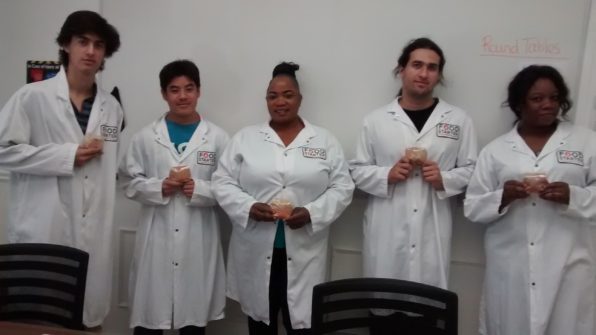
    Together with the help of students and volunteers, we were able to produce a first run of the soup that will be sold by FoodShare. For every soup sold, another will be provided to the food bank, ensuring everyone will have access to a healthy, easy to prepare and delicious meal.
    img_20160902_125406958

    Currently we are looking to partner with a school in order to use the soup production and sale process as part of an educational program. This soup program is community oriented, sustainable and provides a long term food solution to the public.

    Letting People Be Heard

    In 2015 the Toronto Poverty Reduction Strategy was passed during a city council meeting. The goal of the strategy is to address immediate needs such as housing, transportation and food insecurity. I was able to attend a meeting regarding the strategy with NYH Board Chair, Kerry Mitchell to share the perspective of our clients with the mayor and city council. While we work very hard to advocate on behalf of our clients, we also want to establish processes and forums for clients to advocate on their own behalf and share their stories with our city’s decision makers.

    This year we are putting together a Speaker’s Bureau within the North York Harvest Food Bank network. This will enable individuals that are experiencing poverty or living in poverty and using programs such as food banks to have their voice be heard as well as amplify the collective voice of our clients. We hope that this program will educate our community and provide more insight into the lives of those we serve.

    I am truly looking forward to what we have in store for the upcoming year!

    What most interests you about these subjects? Is there something else that we’re missing? Want to get involved? Let YOUR voice be heard and let me know by dropping me an email at ryan@northyorkharvest.com

    Here’s to a food friendly 2017!

    Subscribe to Our Enewsletter

    * indicates required


  7. Sharing What We Have

    Comments Off on Sharing What We Have

    donor-lynne-just-her-face-and-torso

    Guest blog by Lynne

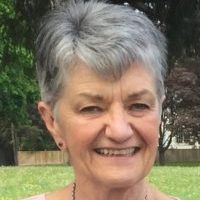
    “We take a lot of things for granted,” Lynne, long-time donor of the food bank shares. “Basic things like clothes, blankets and especially food.”  This is one of the reasons that drew Lynne to the food bank. This is her story.

    For the longest time we didn’t have a refrigerator.  I would take my toy buggy with me and walk with my mom to the grocery store every day.  Food was scarce but I don’t remember going super hungry. We lived by the waterfront and there were always men asking my grandparents if we had work for them.  “We share what we have,” was my grandma’s philosophy. She would always invite them in and even when there was no work, she would make them some lunch before they left. Kids were always coming to our house for lunch.  Food and community were a big part of our lives.  That was a long time ago. But even today food and community are still an important part of my life.

    I eventually went on to study home economics and early child education at university. Eventually I started working in the inner city supporting moms with prenatal care and nutrition. There are a lot of families that were financially compromised and we spent a lot of time focusing on the importance of healthy food – where to get it, how to make it economically and what they could use to make healthy meals without spending too much.  But it wasn’t only about food.  After all, community is a big part of the equation. After my first husband passed away I was a single mom trying to work, take care of my children and make ends meet.

    I often would share food with my neighbours who were also struggling, often because life was hard and lonely and sharing food brought us together and brought so much joy.

    It’s no surprise that the same focus on sharing what you have, food and community was passed from my grandparents through my family to my children.  When our kids were growing up, food and giving was a part of the family culture.  We tried to eat dinner together as much as we could and during the holidays we would come together to make Christmas hampers.  It was a family tradition. Even now, though my kids are older we still come together, four generations of family and they do it every year.

    I started to support the food bank because it simply made sense. There are so many families out there without enough food to eat.

    I may not be able to give to all of them directly but I can partner with an organization that is working to do that.  You don’t have to be wealthy, you just have to share what you have. I tell my kids that all the time.  Because none of us exist on our own.

    We are part of something bigger, bigger than just ourselves and giving is a part of that, a part of our lives.


    And that is exactly what North York Harvest Food Bank, with the generous support of Lynne and donors just like her are doing.  Like the philosophy that Lynne’s grandparents lived by whatever we have we share. Join Lynne and the other amazing NYH supporters to ensure that no family in Toronto goes hungry this fall.

    Donate a generous gift of $500 or more and join Lynne in the Harvest Circle – our leadership donors paving the way for a Toronto where no one goes hungry.

     Want to make another gift?  Every $1 donated provides 3 meals for someone that is hungry! Click here.


  8. The Cost of Poverty

    Comments Off on The Cost of Poverty

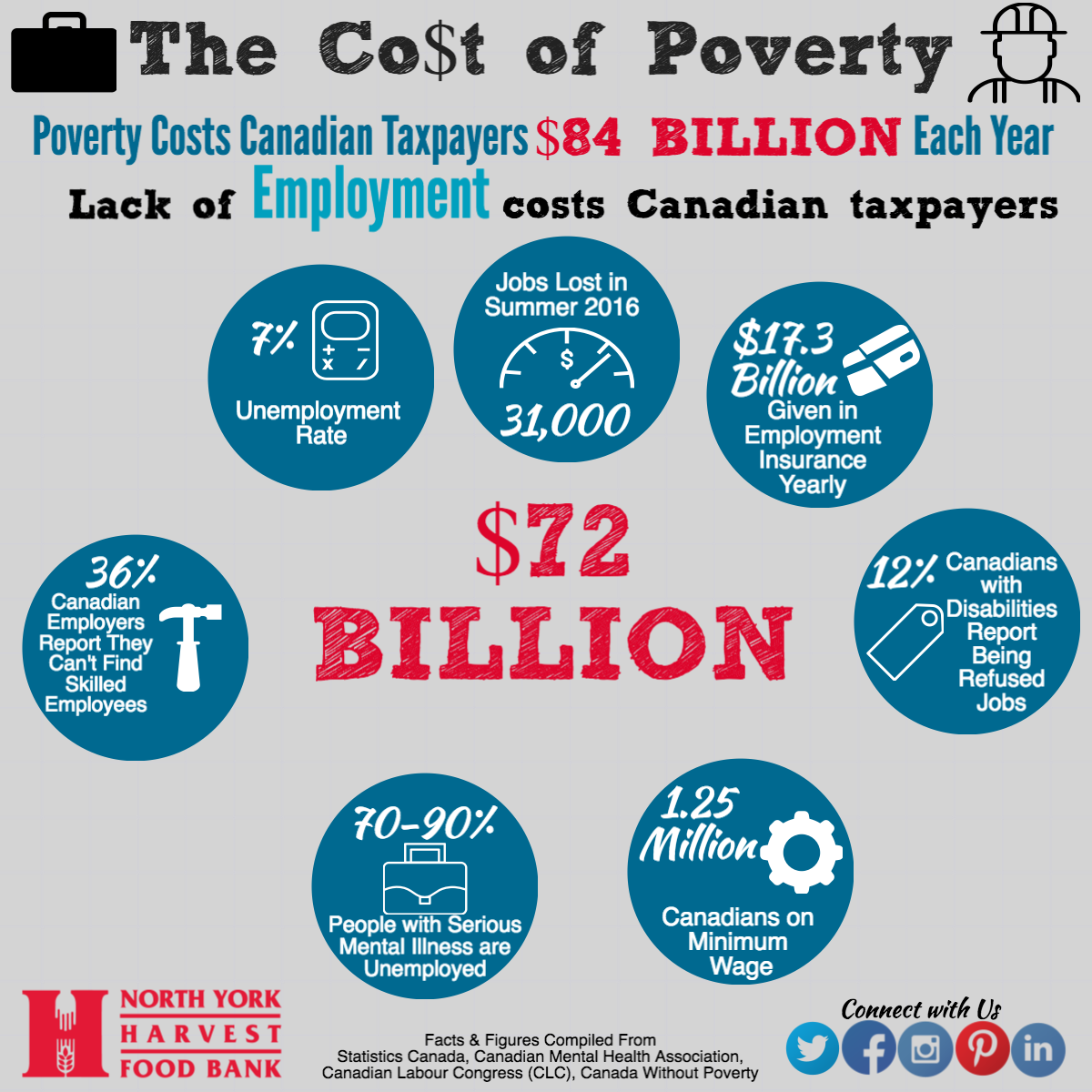
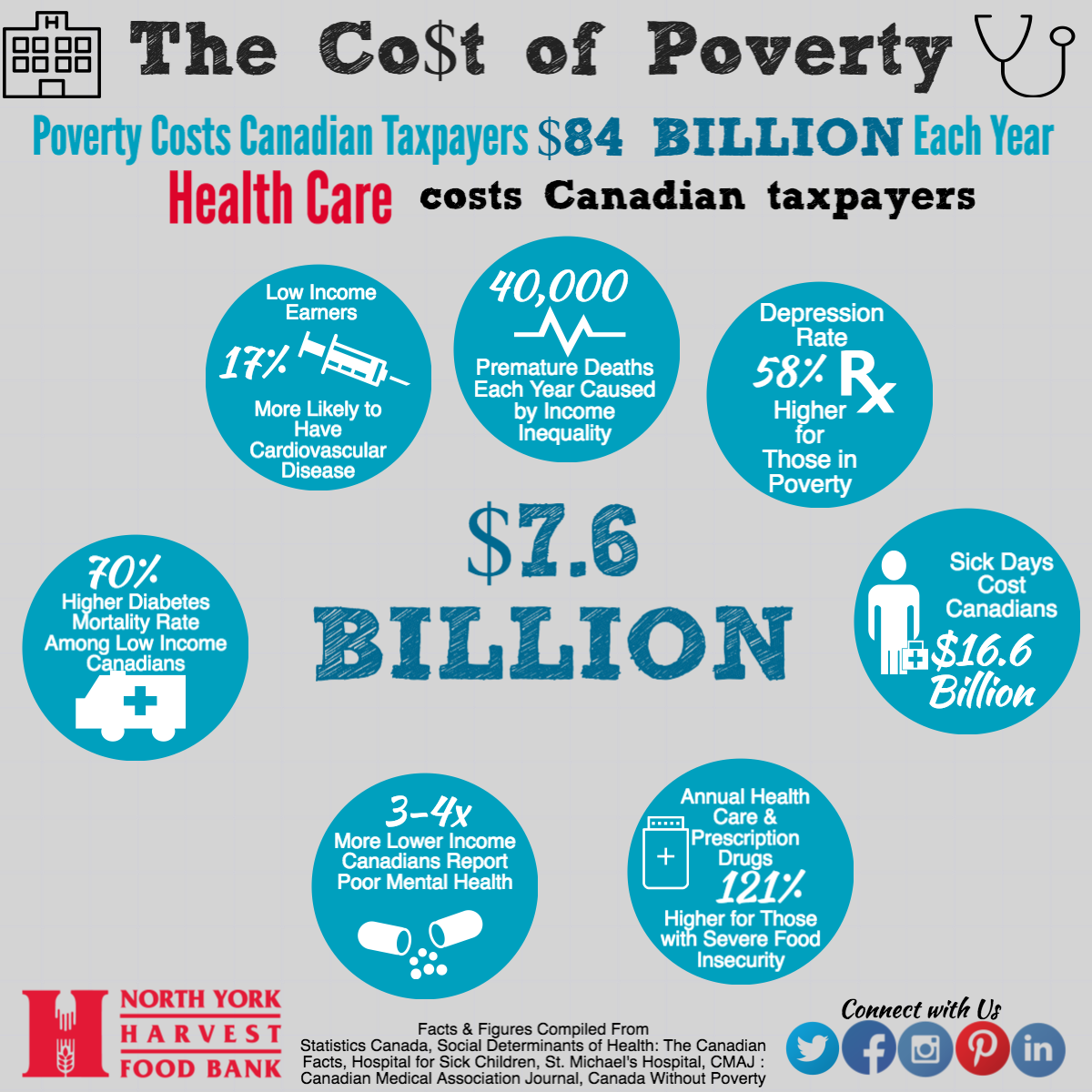
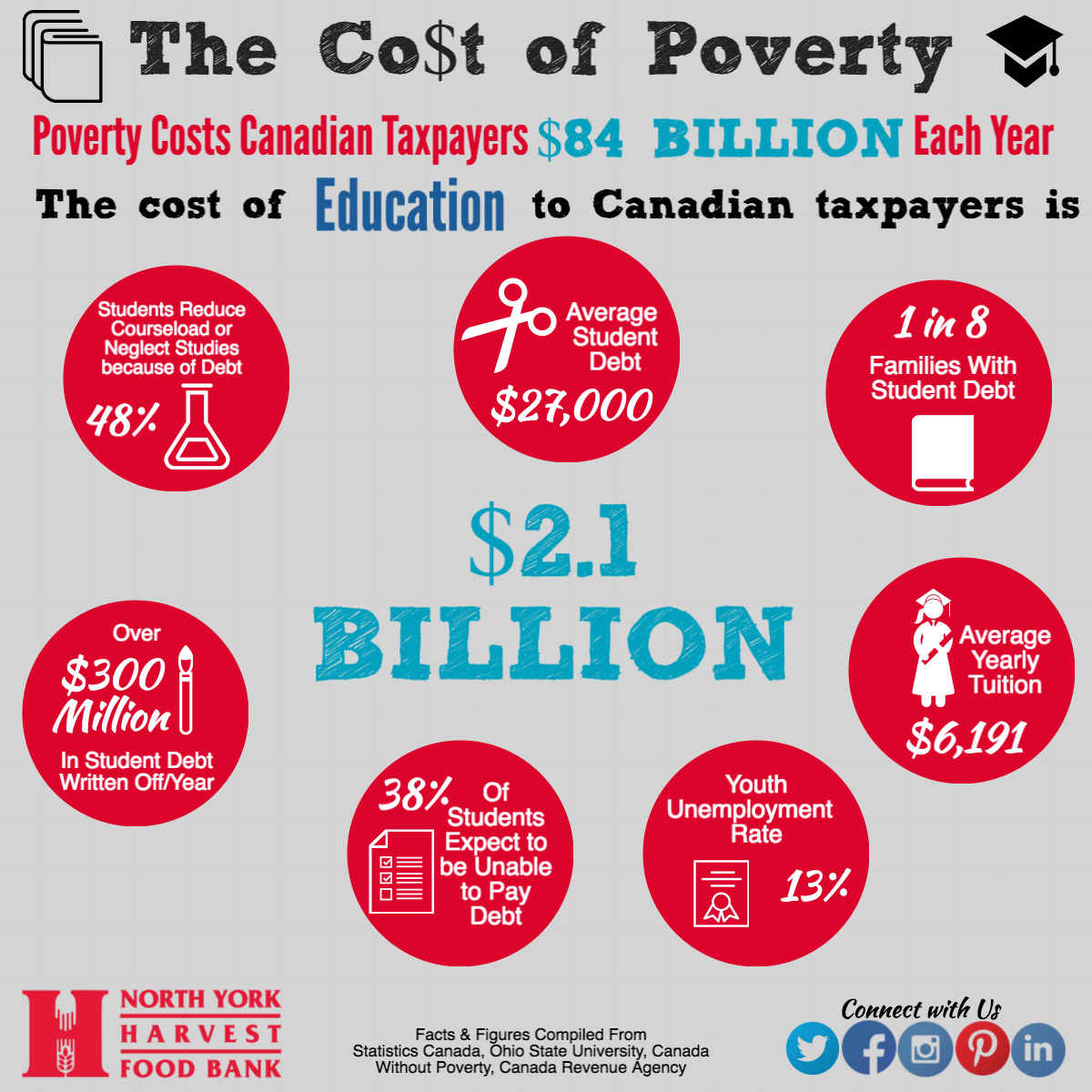
    Poverty affects more than just the thousands of Canadians struggling with it every day. In fact, poverty costs the Canadian Taxpayers over $84 Billion Dollars EVERY YEAR.  Our taxes are used to cover the different areas, many of which are affected and increased by poverty – education, lack of employment and health care being the most prevalent.

    Did you know that taxes do not pay for any food support provided by our 47 member agencies? We rely on the generous donations of people like you to ensure we can help our neighbours in need.  But NYH is not just a food bank.  Together we are also working to provide training, referrals, child care food delivery and job support.  Stay tuned for our new Logistics Training Program which will utilise our warehouse to train people and help them access employment opportunities while ensuring food is delivered to our agencies.

    Sign up for our newsletter to stay informed.

    poverty-5c-5c-5_16805677_f0982965df1b378dac48e81145a99503b1f011b4

    poverty-employment

    poverty-health

    Help us make an impact in our community.  Get involved with North York Harvest today!